Extremists: Studies in Metapolitics by Jonathan Bowden
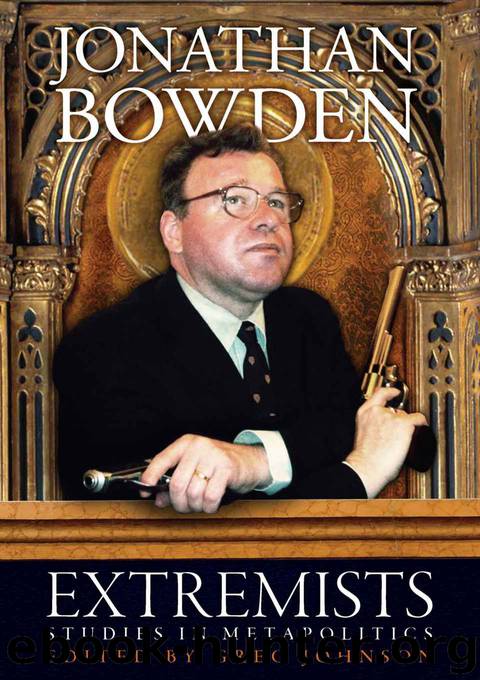
Author:Jonathan Bowden
Language: eng
Format: mobi, epub
Tags: Martin Heidegger, Maurice Cowling, Gabriele D'Annunzio, Julius Evola, Thomas Carlyle, Yukio Mishima, Charles Maurras, Savitri Devi
ISBN: 9781940933498
Publisher: Counter-Currents Publishing
Published: 2017-07-30T22:00:00+00:00
JULIUS EVOLA:
THE WORLD’S MOST RIGHT-WING THINKER17
This is the twenty-seventh meeting of the New Right, and we’ve waited quite a long time to discuss one of the most important thinkers of the radical Right and of a Traditional perspective upon mankind and reality, and that is Baron Julius Evola.
Now, Evola is in some respects to the Right of everybody that we’ve ever considered in nearly any of these talks, and not in a sort of unprofound or sententious manner. Julius Evola was somebody who rejected purposefully and metaphysically the modern world. Now, what does that mean? It basically means that at the beginning of the last century, Baron Evola, who is a Sicilian baron,18 decided that there are about four alternatives in relation to modern life for those of a heroic spirit.
One was suicide and to make off with one’s self by opening one’s veins in the warm bath like Sicilian Mafiosi and Italian cardinals and Sicilian sort of brigands and ancient Romans.
Another was to become a Nietzschean, which for many people in Tradition is a modern version of some, but by no means all, of their ideas, and it’s a way of riding the tiger of modernity and dealing with that which exists around us now. Later, people like Evola and other perennial Traditionalists, as we may well call them, became increasingly critical of Nietzsche and regard him as a sort of decadent modern and an active nihilist who has a bit of spirit and vigor, but doesn’t really have the real position.
I make things quite clear. I would be regarded by most people as a Nietzschean, and philosophically that’s the motivation I’ve always had since my beginning. That’s why parties don’t really mean that much to me, because ideas are eternal and ideas and values come back, but movements and the ways and forms that they take and expressions that they have come and go.
Now, moving from the Nietzschean perspective, which of course relates to the great German thinker at the end of the nineteenth century and his active and quasi-existential and volitional view of man, is the idea of foundational religiosity, or primary religious and spiritual purpose. In high philosophy, there are views which dominate everyone around us and modern media and everyone who goes to a tertiary educational college, such as a university, in the Western world. These are modern ideas, which are materialistic and anti-spiritual and aspiritual and anti-religious, or antagonistic to prior religious belief so much so that it’s taken as a given that those are the views that one holds. All of the views that have convulsed the Western intelligentsia since the Second European Civil War which ended in 1945, ideas like existentialism and behaviorism and structuralism and so on, are all atheistic and material views. They’ve been discussed in other meetings. As one goes back slightly, one has various currents of opinion such as Marxism and Freudianism and behaviorism beginning in the late nineteenth century and convulsing much of the twentieth century.
But these are views that an advanced Evolian type perspective rejects.
Download
Extremists: Studies in Metapolitics by Jonathan Bowden.epub
This site does not store any files on its server. We only index and link to content provided by other sites. Please contact the content providers to delete copyright contents if any and email us, we'll remove relevant links or contents immediately.
| Anthropology | Archaeology |
| Philosophy | Politics & Government |
| Social Sciences | Sociology |
| Women's Studies |
The Secret History by Donna Tartt(19088)
The Social Justice Warrior Handbook by Lisa De Pasquale(12190)
Thirteen Reasons Why by Jay Asher(8910)
This Is How You Lose Her by Junot Diaz(6887)
Weapons of Math Destruction by Cathy O'Neil(6280)
Zero to One by Peter Thiel(5802)
Beartown by Fredrik Backman(5754)
The Myth of the Strong Leader by Archie Brown(5507)
The Fire Next Time by James Baldwin(5446)
How Democracies Die by Steven Levitsky & Daniel Ziblatt(5218)
Promise Me, Dad by Joe Biden(5153)
Stone's Rules by Roger Stone(5088)
A Higher Loyalty: Truth, Lies, and Leadership by James Comey(4964)
100 Deadly Skills by Clint Emerson(4925)
Rise and Kill First by Ronen Bergman(4789)
Secrecy World by Jake Bernstein(4753)
The David Icke Guide to the Global Conspiracy (and how to end it) by David Icke(4719)
The Farm by Tom Rob Smith(4511)
The Doomsday Machine by Daniel Ellsberg(4490)
